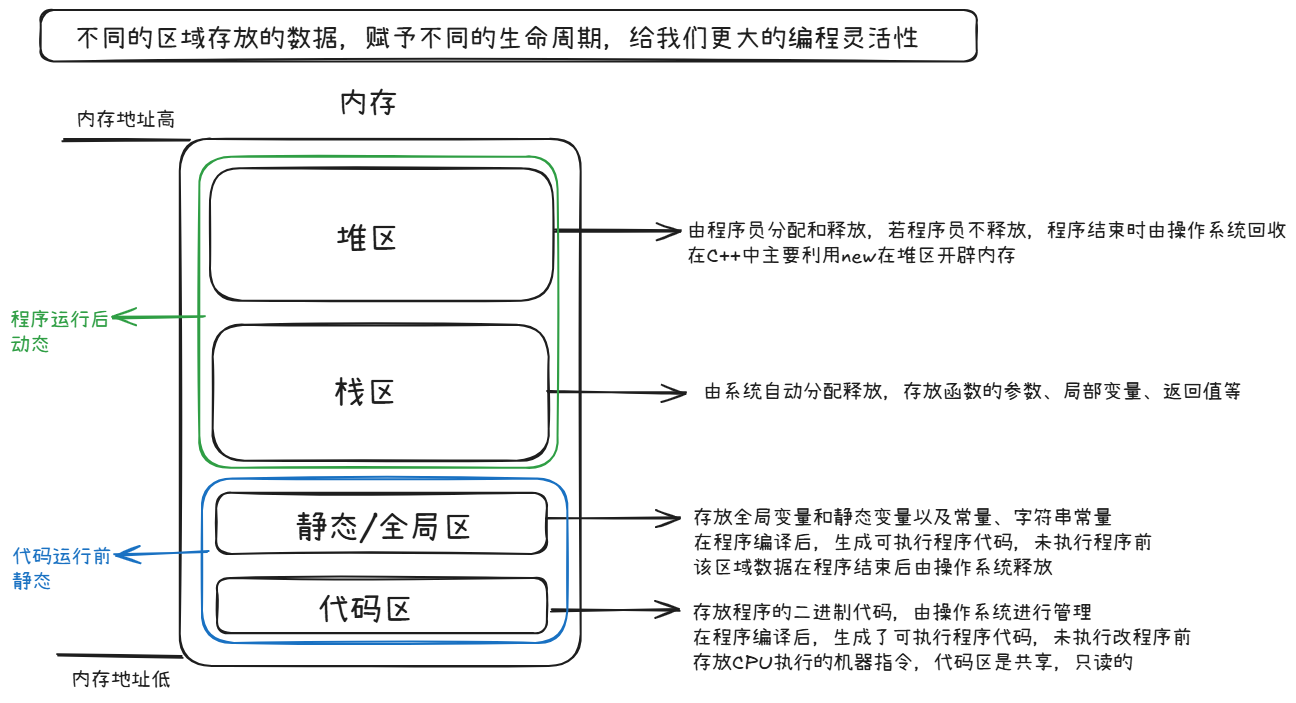
内存分区模型 内存分区模型
new操作符 C++中利用 new 操作符在堆区开辟内存空间用来存放数据
利用new开辟的空间,会返回该空间的首地址
基本用法:
定义一个person类,名字使用动态字符数组在堆内存保存(RAII模式初接触)
1 2 3 4 5 6 7 8 9 10 11 12 13 14 15 16 17 18 19 20 21 22 23 24 25 26 27 28 29 30 31 32 33 34 35 36 37 38 39 40 41 42 43 #include <iostream> #include <cstring> using namespace std;class Person { private : char * name; int age; public : Person ():name{},age{}{} Person (char * name,int age):age{age}{ this ->name = new char [strlen (name)+1 ]; strcpy (this ->name,name); } char * getName () { return name; } void setName (const char * n) { delete [] name; name = new char [strlen (n) + 1 ]; strcpy (this ->name,n); } int getAge () const { return age; } void setAge (int age) { this ->age = age; } ~Person () { delete [] name; } }; int main () Person p{"ethaniel" ,20 }; cout << "p的name:" << p.getName () << " p的年龄:" << p.getAge () << endl; return 0 ; }
引用 作用:给变量起别名
语法: 数据类型 &别名 = 原名;
1
2
3
4
5
int a = 10 ;int &b = a;cout << "a: " << a << " b: " << b << endl; b = 100 ; cout << "a: " << a << " b: " << b << endl;
注意事项:
做函数参数 1 2 3 4 5 6 7 8 9 10 11 12 13 14 15 16 17 18 19 20 21 22 23 24 25 26 27 28 29 30 void mySwap1 (int a,int b) int temp = a; a = b; b = temp; } void mySwap2 (int *a,int *b) int temp = *a; *a = *b; *b = temp; } void mySwap3 (int &a,int &b) int temp = a; a = b; b = temp; } int main () int a = 10 ; int b = 20 ; mySwap1 (a,b); cout << a <<"," << b << endl; mySwap2 (&a,&b); cout << a <<"," << b << endl; mySwap3 (a,b); cout << a <<"," << b << endl; return 0 ; }
作用:函数传参时,可以利用引用的技术让形参修改实参
做函数返回值 作用:引用是可以作为函数的返回值存在的
1 2 3 4 5 6 7 8 9 10 11 12 13 14 15 int & test () static int a = 10 ; return a; } int main () int &ref = test (); cout << "ref = " << ref << endl; test () = 1000 ; cout << "ref = " << ref << endl; return 0 ; }
引用的本质 本质:引用的本质在C++内部实现是一个指针常量
1 2 3 4 5 6 7 8 9 10 11 12 13 14 15 16 17 18 19 20 void func (int & ref) ref = 100 ; } int main () int a = 10 ; cout << &a << endl; int & ref = a; ref = 20 ; cout << a << endl; cout << ref << endl; func (a); cout << a << endl; cout << ref << endl; return 0 ; }
常量引用 1 2 3 4 5 6 7 8 9 10 int a = 10 ;const int &ref = 10 ;
作用:常量引用主要用来修饰形参,防止误操作在函数形参列表中,可以加const修饰形参,防止形参改变实参
静态成员 static修饰成员 静态成员变量 1 2 3 4 5 6 7 8 9 10 11 12 13 14 15 16 17 18 19 20 21 22 23 24 25 26 27 28 class Student { public : static int age; private : static string name; }; int Student::age = 18 ;string Student::name = "zs" ; int main () Student s1; sout << s1. age << endl; Student s2; s2. age = 20 ; sout << s1. age << endl; cout << Student::age << endl; Student s3; return 0 ; }
1、一般类内声明,类外初始化
静态成员函数 1 2 3 4 5 6 7 8 9 10 11 12 13 14 15 16 17 18 19 20 21 22 23 24 class Student { public : static int age; string name; public : static void study () { age = 18 ; cout << "hhxx" <<endl; } }; int Student::age = 18 ;int main () Student s1; s1. study (); Student::study (); return 0 ; }
1、所有对象共享同一个函数
static修饰成员的应用场景 静态成员变量的应用场景 (1)统计对象的数量
1 2 3 4 5 6 7 8 9 10 11 12 13 14 15 16 17 18 19 class Student { public : static int count; Student (){ count++; } }; int Student::count = 0 ;int main () Student s1; Student s2; Student s3; cout << Student::count << endl; return 0 ; }
(2)共享数据
(3)常量数据
1 2 3 4 5 6 7 8 9 10 11 12 13 class Student { public : static const int num = 10 ; }; int main () Student s1; cout << s1. num << ednl; return 0 ; }
将一个成员变量声明为静态常量,可以在类的所有对象中共享并且不可修改。
静态成员函数的应用场景 (1)访问静态成员变量
静态成员函数可以直接访问静态成员变量,而不需要创建对象
(2)实现工具函数
1 2 3 4 5 6 7 8 9 10 11 12 13 class MathUtils { public : static int add (const int a,const int b) { return a + b; } }; int main () cout << "结果" << MathUtils::add (5 ,3 ) << endl; return 0 ; }
(3)单例模式
保证一个类只有一个实例,并提供一个全局访问点来获取该实例
实现方式:类的构造函数是私有的
目的:限制类的实例化次数,确保在程序运行过程中只有一个实例存在,避免资源浪费和不一致的状态
具体实现方式:
1 2 3 4 5 6 7 8 9 10 11 12 13 14 15 16 17 18 19 20 21 22 23 24 25 26 class Singleton { private : Singleton (){} static Singleton* instance; public : static Singleton* getInstance () { return instance; } }; Singleton* Singleton::instance = new Singleton; int main () Singleton* s = Singleton::getInstance (); Singleton* s1 = Singleton::getInstance (); if (s == s1) { cout << "当前只有一个Singleton实例,即单例模式成立!" << endl; }else { cout << "单例模式不成立!" << endl; } return 0 ; }
懒汉式:
1 2 3 4 5 6 7 8 9 10 11 12 13 14 15 16 17 18 19 20 21 22 23 24 25 26 27 28 29 30 class Singleton { private : Singleton (){} static Singleton* instance; public : static Singleton* getInstance () { if (instance == nullptr ) { instance = new Singleton; } return instance; } }; Singleton* Singleton::instance = nullptr ; int main () Singleton* s = Singleton::getInstance (); Singleton* s1 = Singleton::getInstance (); if (s == s1) { cout << "当前只有一个Singleton实例,即单例模式成立!" << endl; }else { cout << "单例模式不成立!" << endl; } return 0 ; }